Urba · Boscéaz

The story of a rural palace

From the first Neolithic floors to the villa of 170, from medieval quarries to the University of Lausanne excavations.

160–180 CE

A pars urbana two hundred metres long

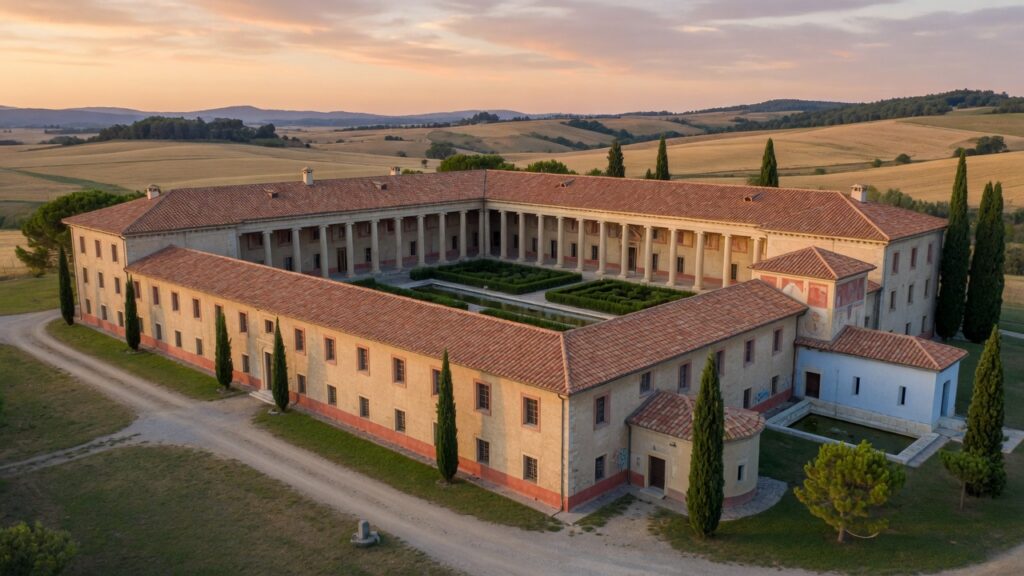
The villa of Orbe-Boscéaz is not a farm. It is a rural palace: more than two hundred metres of façade, pleasure courts, private baths, a mithraeum. Nine of a hundred rooms are paved with mosaics.

This is the civitas of the Helvetii, on a fertile plateau, within reach of the road to Aventicum. The master of the estate had the means of a senator, or of a notable who came close.

The Alamannic invasions finished the building. The walls became a quarry. The floors, too heavy to carry, remained.

From the Neolithic to restoration

The place was occupied long before Rome, and has never stopped being reread.

  1. Neolithic

    First floors

    Occupation attested from the Neolithic, then the Bronze Age and the late Iron Age.

  2. 160–180

    The villa

    Main construction of the pars urbana, baths, mithraeum, mosaics.

  3. 1841

    Rediscovery

    First mosaics brought to light. The Triton and the Labyrinth follow in 1845.

  4. 1896

    Scientific excavation

    Albert Naef leads the first campaigns. Listed as a historic monument in 1900.

  5. 1976

    Aerial view

    Photographs reveal the scale of the estate: 16 hectares, 200 metres of façade.

  6. 1986–2004

    Lausanne

    The University of Lausanne excavates the whole pars urbana and finds Achilles on Skyros (1993).

The mosaics were not taken to the museum. The museum was built around them.

Hélène Vuilleumier

Conservation

A site that is never finished

The Achilles on Skyros pavement, found in 1993, still awaits full presentation. It is shown rarely, and always as work in progress.

The other floors, open to the public in five timber-and-glass pavilions, are watched season after season: frost, humidity, salt, light. An in-situ mosaic is not a painting. It is a climate.

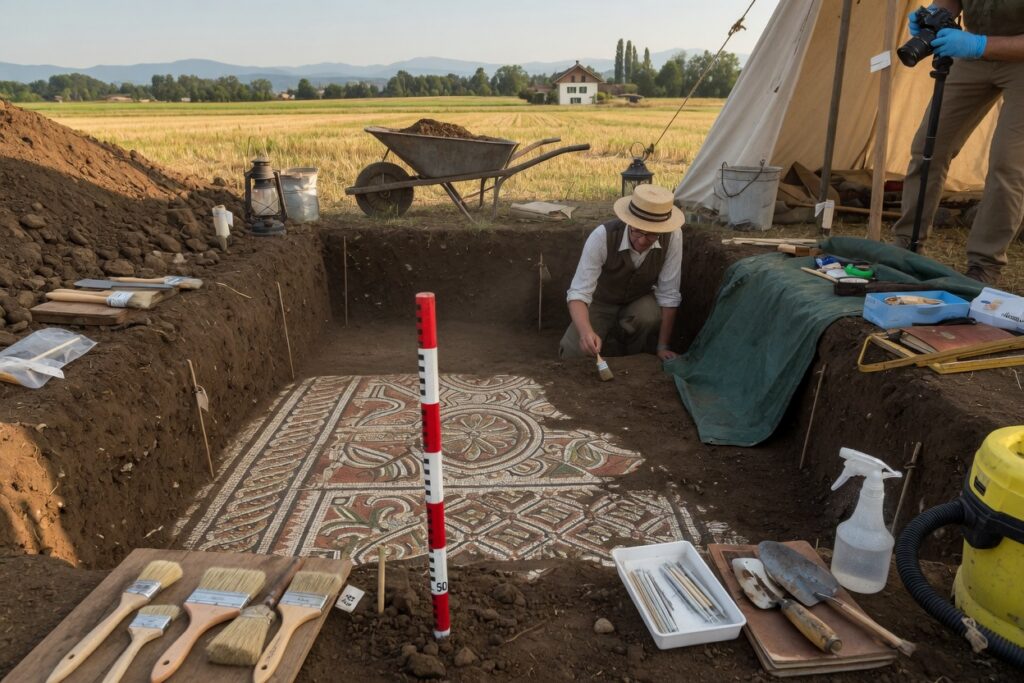
The museum tells that too: patience, brushes, surveys, the refusal to “over-restore”.

The nine floors

Each mosaic has a name, a pavilion, a story of discovery — sometimes of looting, sometimes of rediscovery.